21 Aug The Story of the Saranac Lake Depot
ARTA Blog
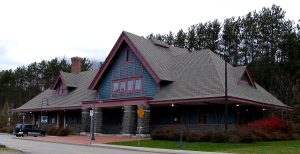
In the heart of the Adirondacks sits one of the most recognizable historic buildings in the village of Saranac Lake — the Saranac Lake Union Depot. More than just an old train station, the Depot tells the story of how railroads transformed the Adirondack region, fueled the growth of Saranac Lake, and connected a remote mountain village to New York City, Montreal, and beyond.
Today, the Depot stands as both a symbol of the village’s past and a centerpiece in its evolving future.
The Railroad Arrives in the Adirondacks
Before the railroad reached the Adirondacks, traveling to Saranac Lake was difficult and time-consuming. Visitors often arrived by stagecoach, wagon, or guide boat after long journeys through rough terrain.
That changed in the late 1800s.
The Delaware & Hudson Railroad reached Saranac Lake in 1887, opening the region to tourism, commerce, and the growing tuberculosis treatment industry. A few years later, the Mohawk & Malone Railway expanded rail service deeper into the Adirondacks, eventually becoming part of the New York Central Railroad system.
Rail travel quickly became essential to the community. Wealthy tourists, outdoor adventurers, medical patients, doctors, and workers all arrived by train. Saranac Lake’s reputation as a healing destination for tuberculosis patients grew rapidly after the work of Dr. Edward Livingston Trudeau, and the railroad became the lifeline bringing patients and visitors into town.
Construction of the Union Depot
The current Depot building was constructed in 1904 by the Delaware & Hudson Railway. Known officially as the Saranac Lake Union Depot, it served both the Delaware & Hudson Railroad and the New York Central Railroad, which is where the “Union” name originated.
The station was strategically located near downtown Saranac Lake, making it easy for visitors to reach hotels, cure cottages, and sanitariums.
Architecturally, the Depot reflected the rugged Adirondack style popular at the time. Its design combined practicality with rustic elegance, featuring broad rooflines, wood construction, and spacious waiting areas intended to accommodate large numbers of travelers.
At its peak, the station handled between eighteen and twenty scheduled passenger trains per day.
A Golden Age of Rail Travel
From the early 1900s through the mid-20th century, the Depot thrived.
Passengers could board trains in New York City and ride directly to Saranac Lake. Luxury sleeping cars and Pullman service brought affluent visitors into the mountains for vacations and extended stays. The railroad also transported supplies, mail, lumber, and goods essential to the growing village economy.
For many arriving patients, the Depot represented hope. Tuberculosis sufferers traveled from across the country seeking treatment in the clean mountain air of the Adirondacks. Families often met loved ones at the station platform, beginning journeys that would shape countless lives in Saranac Lake.
The Depot also welcomed vacationers heading to nearby lakes, camps, and Great Camps during the Adirondacks’ tourism boom.
Decline of Passenger Rail
Like many rail stations across America, the Saranac Lake Depot eventually faced decline as automobiles and highways became dominant.
Passenger rail traffic decreased steadily after World War II. Direct passenger service from New York City ended in the early 1950s, though sleeping car service continued into the 1960s.
The final New York Central passenger train passed through Saranac Lake on April 24, 1965. Freight service lingered for several more years before ending in 1972.
For a time, the Depot sat largely dormant — a reminder of a bygone era when trains defined life in the Adirondacks.
Preservation and Restoration Efforts
Fortunately, local preservationists recognized the Depot’s historic importance before it was lost.
Organizations such as Historic Saranac Lake played a major role in saving and restoring the building. Restoration work during the late 1990s helped return the Depot to much of its former appearance and preserved it as one of the village’s key historic landmarks.
The Depot eventually became home to exhibits, historical displays, community events, and tourism information celebrating both local rail history and the broader story of the Adirondacks.
For many residents, the building became more than a station — it became part of the community identity.
The Adirondack Scenic Railroad Era
Rail activity returned to the Depot in the early 2000s through the efforts of the Adirondack Railroad and the Adirondack Railway Preservation Society.
Scenic tourist trains once again carried passengers between Saranac Lake and Lake Placid from 2000 through 2016. These excursions gave visitors the chance to experience the beauty of the Adirondacks by rail, much as travelers had generations earlier.
Special history trains and seasonal rides helped keep railroad heritage alive while drawing tourism back to the region.
The Rail Trail Transformation
One of the most significant changes in the Depot’s modern history came with the controversial conversion of portions of the rail corridor into the Adirondack Rail Trail.
Tracks between Tupper Lake and Lake Placid, including the section through Saranac Lake, were removed beginning in the early 2020s to create a year-round recreational trail for biking, walking, skiing, and snowmobiling.
The decision sparked passionate debate across the Adirondacks. Some residents supported preserving rail service, while others favored expanded recreational trail access. The conversation became one of the region’s most emotional preservation and development debates in recent memory.
Today, the Depot sits alongside the Adirondack Rail Trail, continuing to serve as a gateway into the village — though now for cyclists, hikers, and outdoor recreation enthusiasts rather than railroad passengers.
The Depot Today
The Saranac Lake Union Depot remains one of the village’s most photographed and historically significant buildings.
In recent years, New York State has explored new ideas for the Depot’s future, including expanded public access, tourism uses, historical interpretation, and community partnerships connected to the Adirondack Rail Trail. (Department of Environmental Conservation)
While trains no longer regularly depart from its platform, the Depot still serves an important purpose: preserving the story of how railroads shaped the Adirondacks and helped build modern Saranac Lake.
For longtime residents, the building evokes memories of arriving trains, bustling platforms, and the era when the whistle of a locomotive echoed through the mountains. For newer generations, it stands as a reminder that Saranac Lake has always been a place defined by movement, resilience, and reinvention.
The Depot has witnessed more than a century of Adirondack history — and its story is still being written.