18 Oct A Brief History of the Ray Brook Rail Station
ARTA Blog
A Brief History of the Ray Brook Train Station
Ray Brook was a designated stop on the Saranac and Lake Placid Railway from the road’s opening in August 1893. Its primary purpose was apparently to afford visitors easy access to Ray Brook House, an esteemed hostelry a ten-minute-or-so walk uphill from the station site—and the approximate current location of the DEC, APA, and State Police Troop B headquarters. The hotel was built, owned, and operated
from 1867 by Duncan Cameron on a large property that he farmed. Cameron was also Ray Brook’s first postmaster, from 1881 maintaining the hamlet’s post office in the hotel. Known for its broad views, the Ray Brook House and its surroundings were photographed more than once by Seneca Rae Stoddard, the Adirondacks’ most famous photographer of the late nineteenth and first years of the twentieth century.
The Ray Brook House was widely known for its easy access to Ray Brook, the stream along which Cameron owned a stretch of land that he annually stocked with trout and “carefully guarded so as to secure the exclusive right to fish to guests of the hotel.” President Grover Cleveland, a devoted angler, made four visits from Saranac Inn to fish and/or dine on trout at Ray Brook House during his first term of office in 1885, ’86, ’87, and ’88. The hotel was sold out of Cameron family hands in 1905 and burned down in 1907. It was replaced by a second Ray Brook House that catered primarily to “health seekers.”
It is uncertain when the first railroad station was built to serve the Ray Brook stop. The Plattsburgh Sentinel, however, mentioned a station in an August 1, 1902, article about the signing of the deed for the purchase of land from the Cameron family and others on which to construct the New York State Hospital for Incipient Pulmonary Tuberculosis. “Ray Brook,” it noted, “has a small railroad station, “built especially for Grover Cleveland several years ago when he went there to fish.”
It is thought that this early station was subsequently replaced around 1907 by a station in the Queen Anne style, which was destroyed by fire on the night of December 9-10, 1928. The Delaware and Hudson, then the railroad’s owner, seemed in no hurry to replace it. This led the New York State Hospital to press the matter in petitioning the State’s Public Service Commission to require the road to rebuild in order to serve its patients. After an early December 1929 hearing (at which the
D and H asked for the opportunity to submit figures covering railroad business at Ray Brook before any ruling was made), the commission ordered the D and H in early January 1930 “to erect and maintain” a suitable station building on the site. It gave the railroad until February 1 to submit plans and specifications for the commission’s approval.
On June 26, 1930, the Tupper Lake Herald and Adirondack Mountain Press reported that J. J. Fitgerald and Sons of Plattsburgh had been given the construction contract for the Ray Brook project. “The station,” it added, will “be one of the most attractive along the five divisions of the Delaware and Hudson railroad.” Details included that the building would “be constructed of colored cement blocks of unique type, which are to be manufactured by the Chateaugay Ore & Iron Co., one of the units of the Delaware & Hudson Company. The coloring of the blocks makes them a most distinctive building material.”
Cement blocks had become an important building material in the early 20th century, at first finished in “rockface” in imitation of traditional masonry. In the late 1920s this style was displaced by smooth-faced blocks, considered “more modern.” Colors could be shaded depending on cement mix ingredients, although grays were predominant.
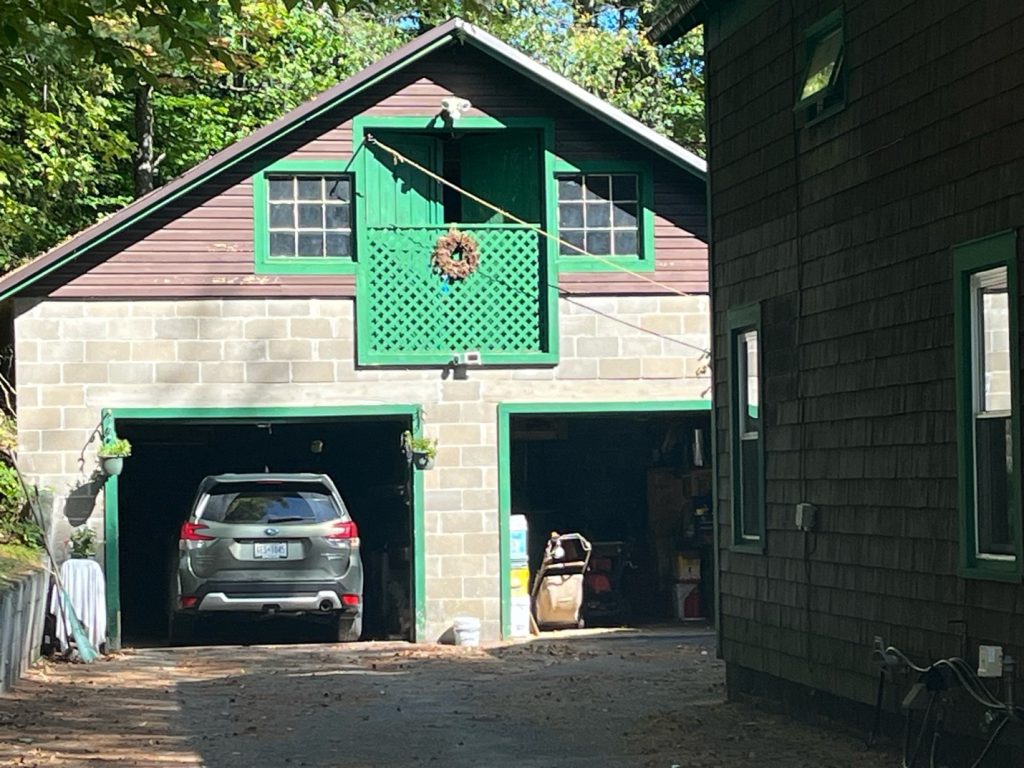
Blocks were generally employed for structural use and veneered with stucco, stone, or brick. Occasionally, however, beige and gray blocks were mixed in the same project, without a stucco coat, as a finished exterior style. (There is a very nice example of this technique in a garage set back on the Route 86 side of the rail trail slightly south of the Brandy Brook Avenue crossing in Saranac Lake.) The coloring mildly compensated for the use of the inexpensive utilitarian material in constructing the 1930 Ray Brook station.
The June 26, 1930, article referred to above stated that the new
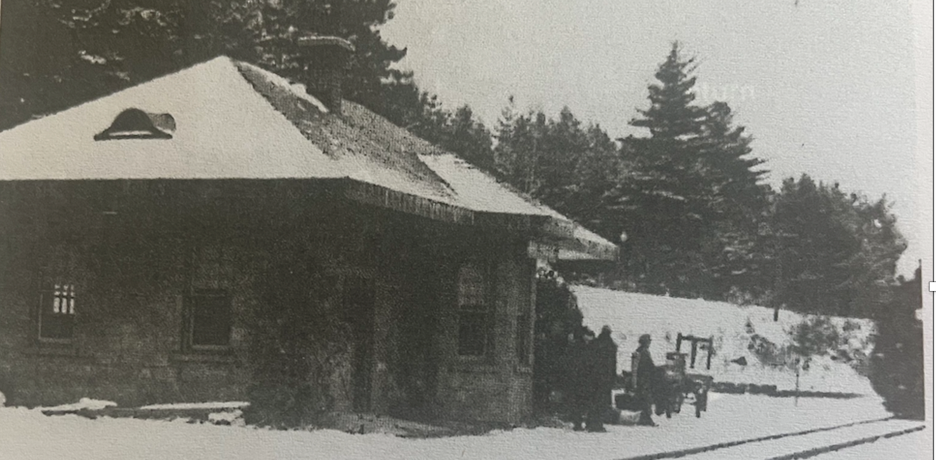
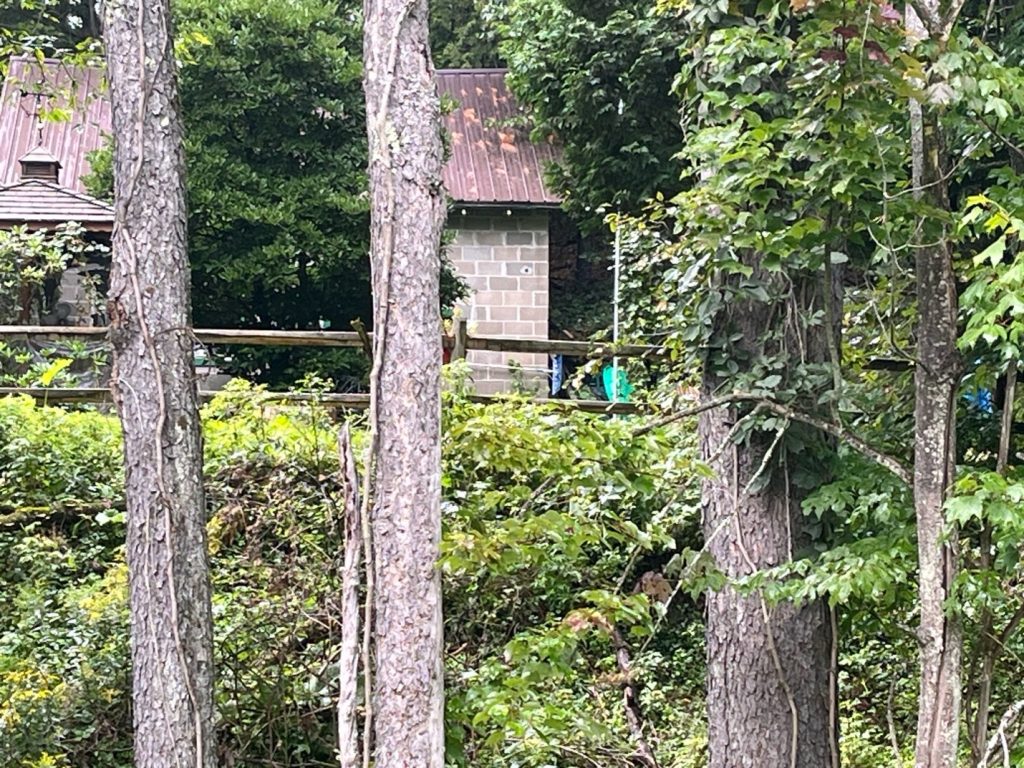
station was to house “a ticket office, a waiting room, baggage and express room and the hospital post office.” Visual observation, however, indicates that the post office section was not part of the original structure, which centered on a multi-sided ticket office extending toward the track, flanked by two wings holding baggage room and waiting room. That the post office section was added later can be observed in the diagonal lines where the corners of the original soffit were cut on both sides of the original roof in extending the building, as well as in the distinctly different style of cement blocks used in the addition. Lost somewhere, probably in enlarging the building, were a pair of eyebrow dormers in the short ends of the original hipped roof as shown in an early photograph.
The Ray Brook station stopped serving passengers when the New York Central Railroad dropped passenger service on its Adirondack Division in 1965. The Ray Brook post office remained in the building until 1975.